
A Synthetic Turf Field Shouldn't Start Over Every Year
Updated: Sep 23
The field carries the evidence. Testing reveals change. Context helps explain why.
One of the biggest problems in synthetic turf management has nothing to do with the turf itself.
It is memory.
A field is installed, and then life happens to it.
Games. Practices. Rentals. Camps. Tournaments. Concerts. Graduations. Community events. Snowstorms. Emergency snow removal. Heavy equipment. Grooming. Repairs. Infill additions.
Some of those events are documented. Many are not. Years later, someone walks onto that field and tries to understand why it looks and performs the way it does.
That is where things get interesting.
The Field Carries the Evidence
We do not believe an asset-management system needs to know every single thing that has ever happened on a synthetic turf field. That would be nearly impossible.
Instead, the field should be evaluated on what it is telling us today. Testing gives us that evidence.
Two fields can be the same age, use the same turf system and sit five miles apart. One may primarily host games and practices. The other may support tournaments, rentals, community events and a concert.
Their calendars may tell very different stories. Eventually, so will the fields.
Surface hardness may change. Infill distribution may become less consistent. Fiber deterioration may become concentrated in particular areas. Structural problems may develop. Performance may become more variable.
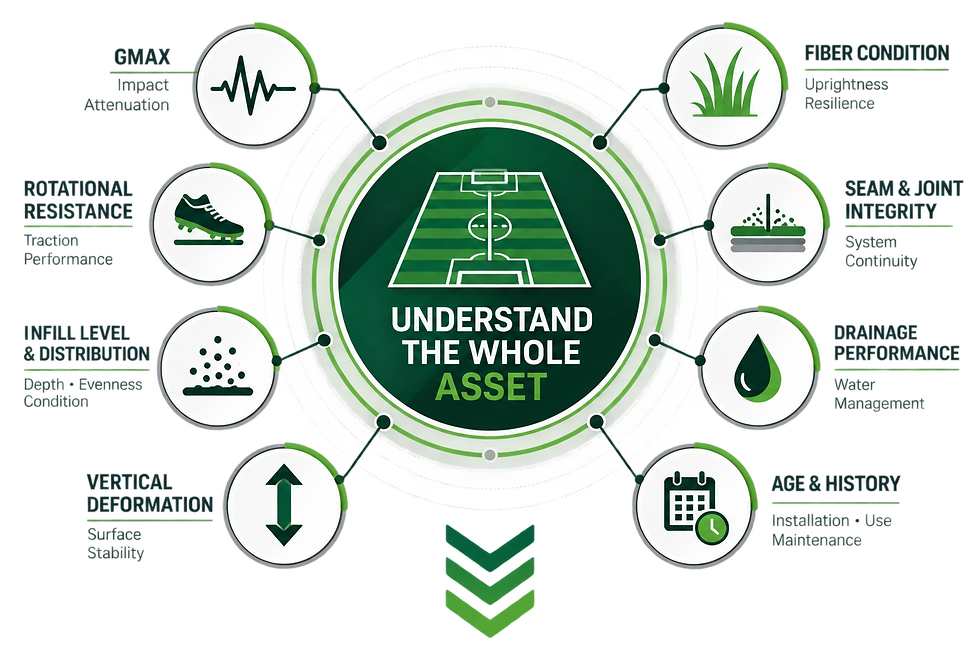
The important point is that we do not have to assume why. We measure first.
Then We Ask the Question
Imagine a field that has been performing consistently for several years. It is tested again, and the results change considerably.
That should trigger a conversation: What happened?
Maybe utilization increased dramatically. Maybe there was a large event. Maybe construction traffic crossed the field. Maybe nothing obvious occurred.
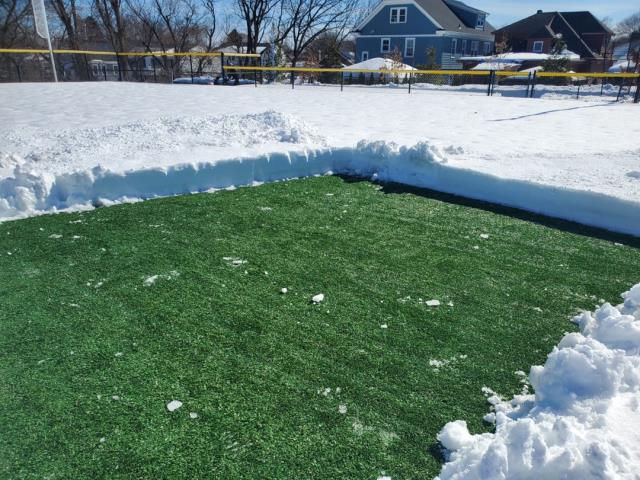
Or maybe the owner says, "We had three feet of snow in early March. We had no choice. We had to plow the field."
Now the testing result has context. The system did not need to know about the storm beforehand. The change in the field created the question, and the owner helped explain the story.
That distinction matters.
Measure first. Explain second.
Condition Determines the Response
Synthetic turf is often evaluated backwards. We know a field is old, so we expect it to be poor. We know a field gets heavy use, so we expect deterioration. We know another field receives regular maintenance, so we assume it should be performing well.
Those are assumptions. The field may tell us something different.
Consistent maintenance matters, but maintenance is not one universal answer. A field can receive regular grooming and still develop a localized condition requiring repair, deeper compaction requiring corrective work, a drainage concern or deterioration that routine service was never intended to correct.
Testing helps us determine what the field actually needs. Sometimes the answer is continued routine maintenance. Sometimes it is a targeted recovery effort, added infill or a structural repair. Sometimes the evidence shows that maintenance alone will not correct the underlying condition and a different capital decision must be considered.
That is the value of condition-based maintenance. The objective is to apply the right response at the right time, then measure what changed.
Our goal with the Turf Performance Index is to evaluate the asset based on the condition that exists, not the condition we expect to find. History, utilization, maintenance and owner knowledge then help explain the result.
Instead of saying, "This field gets a lot of use, so it must be wearing out," we can say, "This field changed significantly since the last assessment. Let's understand why and determine the right response."
Patterns Become More Valuable Over Time
One assessment gives us a snapshot. A second comparable assessment gives us direction. A third begins to create a pattern.
Over time, that testing history can reveal whether a field is remaining stable, responding to an intervention, becoming increasingly inconsistent or showing accelerating deterioration.
The system does not need a perfect diary of everything that happened between assessments. It needs disciplined, comparable measurements.
When something changes, we investigate. Sometimes the explanation will
be obvious. Sometimes it will surprise us. And sometimes the field may reveal something nobody realized was happening.
Every Field Is Evaluated on Its Own Evidence
This matters because synthetic turf fields do not live identical lives.
An eight-year-old field is not automatically worse than a six-year-old field. A heavily scheduled field is not automatically in poor condition. A field receiving consistent maintenance may still require a different intervention. And an unusual event does not automatically damage a field.
Maybe a concert was held and the surface was protected extremely well. The testing should tell us that too.
The objective is not to assign blame for how a field was used or what work was performed. It is to understand how the asset is actually performing, identify meaningful change and make the next decision from evidence.
The Field Builds Its Own Story
That is ultimately what we want from long-term field intelligence: not a massive activity log, assumptions based on age or predictions based solely on usage, but a measurable history of how the field itself has responded over time.
Stable results tell us something. Improvement after an intervention tells us something. A sudden change may tell us even more.
That is when the question becomes valuable: What happened to this field?
Sometimes the answer will already be known. Sometimes the owner will provide it. Sometimes we will have to investigate.
We start with the evidence because every field tells a story. We just need to keep measuring long enough to hear it.
Notes from the Field is a continuing series from TurfOptiX examining what we are learning from real synthetic turf assets, field testing and long-term asset management. Learn more about our approach to synthetic turf maintenance.

Comments